Issue #102: Triathlon
Exploring the pop-punk bands behind the new Focus Records split, LUNA SEA's "ROSIER" and the TVdrama songs from the first half of 2026


Hi! Welcome to This Side of Japan, a newsletter on Japanese music, new and old. You can check out previous issues here.
My favorite drama of the first half of 2026 unfortunately had no tied-in song of sorts to speak of, unless you count the theme that plays along the title call where we see a drones-eye view of Ryuhei Matsuda riding an electric scooter. Hey Detective! Your Backpack is Open finds goofy comedy in the ridiculous cases brought to the titular detective Yusuke Ichinose (Matsuda). If you like dramas like last year’s Hot Spot of people finding the fun and absurd in a plainspoken town, there’s a lot to laugh along with for this one. It’s stupid in a good way. You just go along with whatever it throws at you—like a sentient onsen who can talk to the townies via radio waves—because why not, it’s hilarious if you let yourself believe.
Here are five more shows with music that I enjoyed from the year so far.
“Window” by Kan Sano” [ULTRA-VYBE]
…from Midnight Taxi (June 1 - July 23, Monday - Thursday, 10:45 p.m.; NHK)
Midnight Taxi is surprisingly Kan Sano’s first music gig for a TV show. His breezy hip-hop grooves can easily be smoothed out into elevated hi-fi beats to watch dramas to. The cosmopolitan feel of his tracks make for a great companion for the show’s opening title roll, which finds the titular taxi cab driving through the late-night streets of Tokyo. As of this writing, the soundtrack has yet to be released with the closest thing to an official stream being Kan Sano himself playing the show’s main theme on his piano.
One song from Midnight Taxi that you can hear outside of the show is “Window,” also found in Kan Sano’s latest album, MOJACAT. Compared to, say, the drunken funk for his duet with UA, he goes for a quiet, reserved piano ballad with a similarly sparse arrangement as the one for his (award-winning!) track for Solitary Gourmet. Based on its low-key vibe, maybe you can guess when “Window” slides in the show. The piano trickles in toward the end of its weekly arc, when the passengers of the cab finally find the answer they were looking for, or when our cab driver Shoko (Kotone Furukawa) returns home to bed after a long night.
Shoko plays therapist to a number of passengers throughout the eight-week run of Midnight Taxi. While the show throws some absurd characters her way—wizards, aliens, time-travelers—the story remains sound partly thanks to Shoko’s cool-headed personality bounding it together: “I don’t think it would be that strange to encounter at least one in a city as big as Tokyo,” goes her typical response whenever she meets her customers. Strange as their backgrounds are, their problems humanize them all while leaving Shoko something to ponder about after they’re gone. I’m fond of her time with the time-traveler where she asks if certain things like red-bean rice exist in his time. They will exist as long as they continue to be of need, he responds, and at the end of the week, Shoko is seen serving red-bean rice—a dish usually served for formal family celebrations—for her dinner together with her family-friends.
The eight-week run of Midnight Taxi continues like this, everyone eventually leaving the cab with their perspective renewed. Shoko continues to drive down the night streets of Tokyo to pick up another passenger, and Kan Sano’s theme rolls in the background.
“Aibansan” by ano [TOY’S FACTORY]
…from Aku No Hana (April 10 - June 26, Fridays, 12 a.m.; TV Tokyo)
Whenever she teams up with Shuichi Manabe, ano manages to cook up a single that carry traces of late-Heisei rock. Maybe it’s just a sensibility rooted in the two from them defining their musicianship primarily during the 2010s. But if the wicked new-wave of “Aibansan” is an update on Manabe’s classic sound, the vulgarity in ano’s lyrics about obsessive love recall the candid tones of her singer-songwriter peers like Seiko Oomori. She doesn’t shy away from oversharing, no care if she comes off overbearing, for this messiness is precisely how it feels in the inside.
This exploration of the ugliness of desire suits a song for the drama adaptation of Aku No Hana—my first time with Shuzo Oshimi’s story in any format. After getting caught taking home his school crush Saeki’s gym clothes, eighth-grader Kasuga (Suzuki Fuku) has to make a pact with Nakamura (Ano) if he doesn’t want her spilling what he did to the whole school. The more the story progresses, though, the three gets involved in a tricky triangle all based on being wanted, being seen, by each other while living in their maddeningly banal suburb.
The second half of the story, where it recounts Kasuga’s life three years later after the events spawned by the gym-clothes incident, made the drama worth it for me. Now attending high school in a whole different town, he’s trying his best to escape the shadows of his past. It’s when he finally opens up to Tokiwa (Aruno Nakanishi) about where he came from that he can see the misery of his middle-school days more as an outsider looking in. He just craved some sort of spark while feeling walled in from his dead-end town. And in her song as well as her presence in the drama as Saeki, Ano provides.
I honestly wanted to write about the current season of TV dramas, but the songs for it did not hit streaming until maybe four days before deadline for this issue. I was so not confident in me finishing a draft that quick. Maybe next time. Below is more on pop punk, no wave, visual-kei and a whole lot more.
Happy listening!
Album of the Week
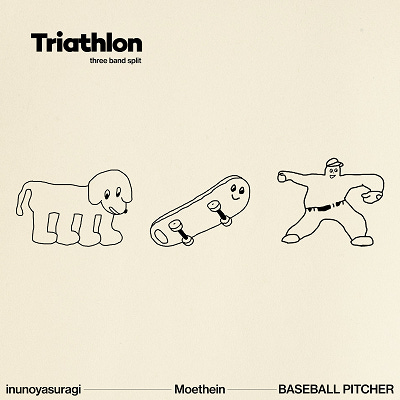
Triathlon by Inu No Yasuragi / Moethein / BASEBALL PITCHER [Focus]
Listen to it on Bandcamp
While Focus Records has been highlighting more individual acts this decade, the indie label continues to strike out great releases by gathering multiple bands in the space of a single record. My first exposure to Focus, the 2024 tape Feelin’ Pop vol. 1 rounds up several bands who were billed to play at the release tour of POWERBOY’s single “First Time,” and what was a promotional giveaway introduces a community of quality local pop punk to an outsider like myself. This is just what the label has always done, stretching back to 2017 with their Shikoku Melodic Sampler series.
Continuing with the label’s collaborative spirit, the new split EP Triathlon houses three buzzing bands under one roof. The record kicks off with the plaintive pop punk of BASEBALL PITCHER, a returning band who manned Focus’s previous split release last year, and it slides through a gradient of styles going into the exuberant power pop of Moethein and then the fuzzy emo of Inu No Yasuragi.
While it’s released as a CD, Triathlon showcases its performers like a vinyl single. After cracking the compilation open with splashy first impressions in the initial round of tracks, each of the three teases an alternative side to their sound in their second go. With the disc’s latter half suggesting the possibility of more to their sound than what lets on from this split release, I wanted to dive deeper and process the music by each of the bands featured in Triathlon at a more individual level. Here’s more about the three acts from Focus’s newest three-way split release.
BASEBALL PITCHER
BASEBALL PITCHER / Sweet Summer Orange - Split (2025)
Upon a fresh first listen of Triathlon, it seems as though BASEBALL PITCHER might have picked the wrong first batter. “Maybe it doesn’t matter” is the more hooky one from them as it delivers a more straightforward punk riff and a sturdier beat; the melancholy peeking out of the actual record-opener “Platform” seems rather reserved for the typical B-side. Yet listen to their demos from the past few years, and it becomes obvious that the band wears an emo heart underneath its pop-punk clothing. “If that’s when it’s goodbye / I should have held you as long as time allowed,” guitarist-vocalist SUPERTURBO laments in the bleeding chorus of “Platform.” With their spiky riffs dampened by their ruminative ways, this is BASEBALL PITCHER in their natural state.
The band picked at their emotional scabs in Focus’s previous split release last year, featured with another of the label’s mainstays Sweet Summer Orange. “Take a Picture” finds them reuniting with a friend, where they can’t help but preemptively mourn the long time they would be apart again rather than enjoying the moment together, and their mellow riffs start to resemble their defeatism in vibe. Their slight bummer nags even at their fulfilling moments. “After you went back your home / My heart still fluttered somehow,” SUPERTURBO sings with relief in “Let’s Go to the Zoo.” “I’m gonna praise myself / for not overlooking this feeling.” And the delicate riffs play as though the band is approaching this rare moment of joy with caution.
Considering the wariness behind the band’s music, “Maybe it doesn’t matter now” sounds like optimism for BASEBALL PITCHER. They deal with the passing of time with a shrug, putting an end to their thoughts with the song’s titular line, and the beat steadily moves on. It’s a sense of peace perhaps better appreciated after being familiar with the band’s anxieties.
Moethein
“Skate Song” (2025)
Like a good student of pop punk, Moethein understand what humanizes great songs about youth: the narrow, black-and-white life perspectives and the infinitely wide feeling of possibility. Last year’s E.P. (Summer Glow) is an ode to those teenage years where a summer can mark a life-defining era. The season sets the scene for a memorable first love (“Teenage”), and it moves characters to leave their family home to grow into their own (“Mom Goodbye”).
While the band’s songs for Triathlon sounds more single-minded than the teenage narratives of (Summer Glow), they share a similar set of values. “I found a way out / gear up in my kicks,” guitarist-vocalist Kyaw Moe Thein sings in “Clash” as he jams with his band. “Faster than your motorbike / Fill me up with noise.” It’s a rock song about the thrills of playing a rock song, plain and simple. Though, engrossing themselves in the present moment by, say, creating music is sometimes all that matters in the world of a teenager. Moethein try their best to prolong that excitement in their current post-adolescent life like in “Skate Song,” and the exuberance flowing in “Clash” affirms that rush from the here-and-now remains a life necessity.
Inu No Yasuragi
“Dogs” (2024)
The title track to the band’s Dogs EP best explains the attitude behind the music and the name of Inu No Yasuragi—the comfort of a dog. “I don’t care if I’m wrong / I’ll be waiting for you,” bassist-vocalist Hinakonahi sings, and the band’s spirited emo-rock leaves no room for any doubt to settle. Conflict is dealt with a similar positivity in the EP, and any second guessing gets swept away by the easy-going punk music and the breezy melodies sung by dual vocalists Hinakonahi and Nu Wan. That carefree attitude becomes a reliable asset for the band by the end of the record, something to lean on like its namesake.
Inu No Yasuragi look at the brighter side to life again in their songs for Triathlon. The spiky jam of “Nadaraka Dakarana” wouldn’t sound out of place in Dogs as they stumble upon the finer things in an otherwise nondescript day. “Biri Gun” meanwhile brings something fresh though its gossamer opening riff that suggests the start of a dream-pop record than an emo number. Though the music still sounds as energized as their other songs—check out the solo and breakdown in its last third—that new sound adds a touch of wistfulness to a typically lively band. “Don’t forget what’s important,” they sing in unison, and for once, it sounds more like a needed reminder to themselves.
Singles Club
“Growth and Mannerism” by EMA x GyuruQo [ALLT RECORD]
Warbling synths and a slithering guitar riff give off a spook in GyuruQo’s new song, and utaite EMA’s oblique lyrics don’t help to clear any of the unease. I sense a voyeuristic feeling out of the bits and pieces that I can gather from the lyrics of “Growth and Mannerism,” like the singer is admiring another at a distance with a creepy obsessiveness. “And I suddenly fell in love,” goes one of the very few legible lines, which GyuruQo responds in kind by serving a scramble of vocal chops and synth burps, perhaps the sound of their guest singer’s mind glitching in real time. But where this sputtering should give way to an exuberant electropop track, “Growth and Mannerism” settles back into something more nerve-rattling.
Listen to it on Spotify.
See also: “Antenna” by kaza; “iMAGINAry” by NAKISO ft. Hatsune Miku
“Chojinshiki” by OIL JIN [self-released]
Like in the best no wave, OIL JIN tap into a rootless chaos, and the band embodies pure nihilism in “Chojinshiki.” Frontman Matcha3go doesn’t sing as much as he blabbers nonsense over searing punk riffs and ghastly moans from the sax. His lyrics are hardly discernible, not that actually reading along to it provides much clues aside from the aimlessness that’s already apparent from the music at hand: “A running lifestyle / I want to be a horse,” he shouts in the refrain. It’s almost too fitting this riot of a track emerges out of a half-baked Beat Takeshi impression in the band’s new LP, Origin. OIL JIN hit their stride in the album whenever they unlock something wicked in them.
Origin is out now. Listen to it on Spotify/Bandcamp
See also: “Killing Under the State” by and more; “Believee in Paranormal” by TV TAIRIKU ONDO
“Hajimari No Shitaku” by She Side Ship [self-released]
She Side Ship find relief in ambivalence in their indie-rock love letter “Hajimari No Shitaku.” “We drift apart, feeling lighter,” vocalist-guitarist Yuri sings as she greets a departing friend farewell. “Maybe this distance is just enough.” Her band proceeds to shrug out a sigh in the form of a mellowed-out rock jam whose breeziness lends an unexpected comfort within this state of in-between. The goodbye in “Hajimari No Shitaku” seems like a bummer but not completely world-shattering, and She Side Ship suggests that, maybe, everything will be OK even.
Listen to it on Spotify.
See also: “Full Count” by Lucie,Too; “Conifer” by Regal Lily
This Week in 1994…
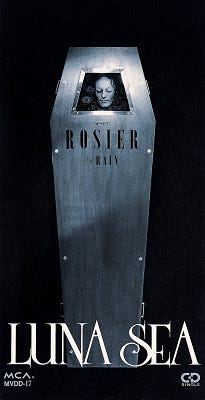
“ROSIER” by LUNA SEA [MCA, 1994]
Highest position at #3 during week of Aug. 1, 1994 | Listen to it on Spotify/YouTube
After a flash of a rose-filled coffin, the camera rotates like a Ferris wheel to track a band of guitar-thrashing punks in goth get-up. Jagged guitars soon lead into a sleeker, silvery riff but not before the operatic frontman hollers out a line also written out in what looks like splattered blood on the drum kit: I AM THE TRIGGER.
“I came across a thing like that on [Countdown TV], which I watched every week, when I was a teen living in the countryside,” shared Chiaki Fujitani, a columnist on visual-kei, to Real Sound in 2016 about stumbling across LUNA SEA and the band’s music video for “ROSIER” on the music program. “It was the coolest thing I’ve seen, and I went to go buy the single the next day. Since I lived in the country, I had to ride my bike for about 10 km to the nearest CD shop.”
For people of a certain generation like Fujitani, the CDTV broadcast during the week of August 1, 1994, must have been a portal into an unseen world. The top two on the charts seemed ordinary, if unremarkable in its plain style. Miki Imai ranked first that week with her adult-contemporary ballad “Miss You,” followed by Mr.Children’s earnest Beatles-esque guitar blues “innocent world.” But the music video for the number-three single, LUNA SEA’s “ROSIER,” introduced to late-night TV viewers a band adorned in an otherworldly look, rocking a far more wicked sound mixing goth, punk and metal — an aesthetic those fans would later associate as visual-kei.
The bands who defined the sound and post-glam visuals of visual-kei also influenced the early music of LUNA SEA. Though LUNA SEA put out their self-titled debut under Extasy Records, an imprint led by YOSHIKI of X JAPAN, they worked less with the speed metal of their label heads than the gothic beat punk of BUCK-TICK and the new wave spilling out of DEAD END’s heavy metal. After signing with a major, their first few albums still followed beat punk’s one-two punctuation with drummer Shinya laying down galloping beats over Inoran and SUGIZO’s glimmering guitar riffs and singer Ryuichi’s wallowing goth-rock vocals.
Like visual-kei as a whole in 1994, LUNA SEA’s breakthrough single found the band growing out of their influences to come into a sound of their own. Shinya lays out a groovier beat than what’s come before it, the track no longer bound by the rigid drilling of the beat-punk one-two. Inoran and SUGIZO nail a perfect balance of thrash-metal grit and art-rock grace with their twin guitar work. While the spiky punk riffs and metal screeches jostle you into the throes of a live-show pit, the more glittery textures lend the track to drift into an ethereal realm.
While the sound of “ROSIER” sets the song apart from the band’s roots, the lyrics represent the quintessential subjects of visual-kei. Violent desire brews inside the aggressive punk, and a deep self-loathing animates much of “ROSIER,” which culminate in its interlude with a monologue recited in English. “Exists only sever / lonesome and cruel reality / But I still search for light,” a voice mutters over the punk thrashing. “Whether I bloom or fall, is up to me / I am the trigger.”
“It was my last will, a farewell to my past self,” bassist J said to Sponichi Annex in 2025 about the monologue. He opens up in his memoir MY WAY about experiencing heavy stress after his band released 1993’s Eden, falling into writer’s block and ultimately shutting himself off from the rest of the world out of frustration.
“Because I cared so much, it started to turn into pressure, and then I hit a wall,” J said about the time to Kyodo News in 2025. “But I think the suffering from that time is what gave me the inspiration to think of something new.” That same pain sparked in J a draft for what would become “ROSIER.” As the main voice behind the record, Ryuichi’s histrionic vocals channeled this all-consuming misery while playing up the self-flagellation as he succumbs to his own fatalism. The more sorrowful it gets, from being denied love by this world, the more vibrant it turns, Ryuichi calls out in the titular chorus about his “rosy heart” — summing up the classic gothic drama explored in so much of the music of LUNA SEA and their visual-kei peers.
The grand display of one’s own suffering in “ROSIER” tapped into a sound and movement much larger than the band. But LUNA SEA’s single brought a glimpse of a bubbling scene to an unsuspecting crowd just as the scene was starting to splinter. By 1994, different modes of visual kei began to split off in reaction to its booming popularity. Some aspired to steer the focus away from the visual aspect and back to the music while others doubled down on the theatrics. New bands hit the scene who would be an even bigger messenger of the whole enterprise. But while others would crystallizee the shape of visual-kei to come, the gothic language of “ROSIER” helped turn the mysterious into the familiar.
This Side of Japan has a Ko-Fi as a tip jar if you want to show appreciation. A subscription to This Side of Japan is free, and you don’t have to pay money to access any published content. I appreciate any form of support, but if you want to, you can buy a Coffee to show thanks.
Next issue of This Side of Japan is out August 19. You can check out previous issues of the newsletter here.
Need to contact? You can find me on Twitter or reach me at thissideofjapan@gmail.com